
Dead Tree Removal: Why Waiting Is Risky
When a tree dies on a property in Syracuse, most homeowners do not call anyone right away. The tree still looks like it belongs there, still has bark, still throws a shadow across the yard, and from the street it might not look much different than it did last summer. But dead tree removal in Syracuse NY is not something to put off. A standing dead tree loses structural integrity every day it stays up, and there is no reliable way to predict exactly when a branch, a limb, or the whole trunk is going to come down. A tree that looks stable in July can turn into a serious hazard by the time the first heavy wet snow hits in November.
How to Tell a Tree Is Actually Dead, Not Just Dormant
Central New York winters make this confusing. A tree that has dropped all its leaves in October and looks bare through March can seem dead when it is only doing what it does every year. The real signs of a dead tree show up in a few specific places. Bark that is peeling away in large sheets, especially near the base or along the trunk, usually means the layer underneath has died. If you scratch a small patch of bark on a branch with a pocketknife and see dry brown wood instead of moist green tissue, that branch is dead, and if the whole trunk tests the same way, the tree probably is too.
Another clue is the scratch test done in spring. By late April or May, a living tree in this region should be pushing out new buds or at least showing green when you nick a twig. A tree that stays bare into June while everything around it leafs out is very likely dead. Mushrooms or shelf fungus growing at the base of the trunk or on exposed roots are another strong signal, since that fungus is often feeding on decaying wood inside the tree. Woodpecker activity, especially large irregular holes rather than small feeding pecks, often means the birds have found insects living in wood that is already soft and dying from the inside.
Canopy dieback that starts at the top and works down is common in stressed or declining trees around Syracuse, particularly ash trees dealing with emerald ash borer, and mature maples and oaks weakened by root damage or years of drought stress. If the top third of a tree is bare branches with no bark left while the bottom still has some green, that tree is on its way out even if it is not fully dead yet.
Why a Dead Tree Gets More Dangerous the Longer It Stays Up
A dead tree does not just stand there quietly waiting to be dealt with. Once a tree dies, decay organisms and insects go to work on the wood immediately, and that process only accelerates over time. Fungi break down the cellulose that gives wood its strength, so a trunk that looks solid on the outside can be soft and punky just a few inches in. Carpenter ants and other wood boring insects hollow out sections of trunk and major limbs, sometimes leaving almost nothing but a thin outer shell holding the tree together.
At the same time, the root system is dying along with the rest of the tree, which means the anchorage holding it in the ground is weakening too. A living tree with a healthy root system can flex and hold its ground in strong wind. A dead tree with compromised roots can go over in wind that would not bother a healthy tree at all, and it often happens without much warning.
This is where the Central New York climate makes things worse. The freeze and thaw cycles we get from November through March force water into cracks in the wood, where it expands as it freezes and pushes those cracks wider. Lake effect snow off Lake Ontario can dump a foot or more of heavy wet snow in a single event, and that snow load settles on brittle dead branches that have already lost the flexibility living wood has. Ice storms coat every surface in a layer of ice that can weigh branches down far past what they were ever built to hold. A dead tree that might have survived one more summer standing quietly in a yard often cannot survive its first real winter storm, and it tends to fail exactly when conditions make removal and cleanup hardest.
What the Removal Process Looks Like
Our tree removal process for a dead tree is not the same job as removing a healthy one, and a crew that knows the difference approaches it differently from the start. The first step is always a hazard assessment. A trained arborist looks at the lean of the tree, checks which way the canopy is heaviest, and figures out where it wants to fall naturally versus where it needs to be directed. With a dead tree, that assessment also includes checking how solid the wood actually is, since a trunk that looks fine from the ground can be hollow enough to change how the whole job gets rigged.
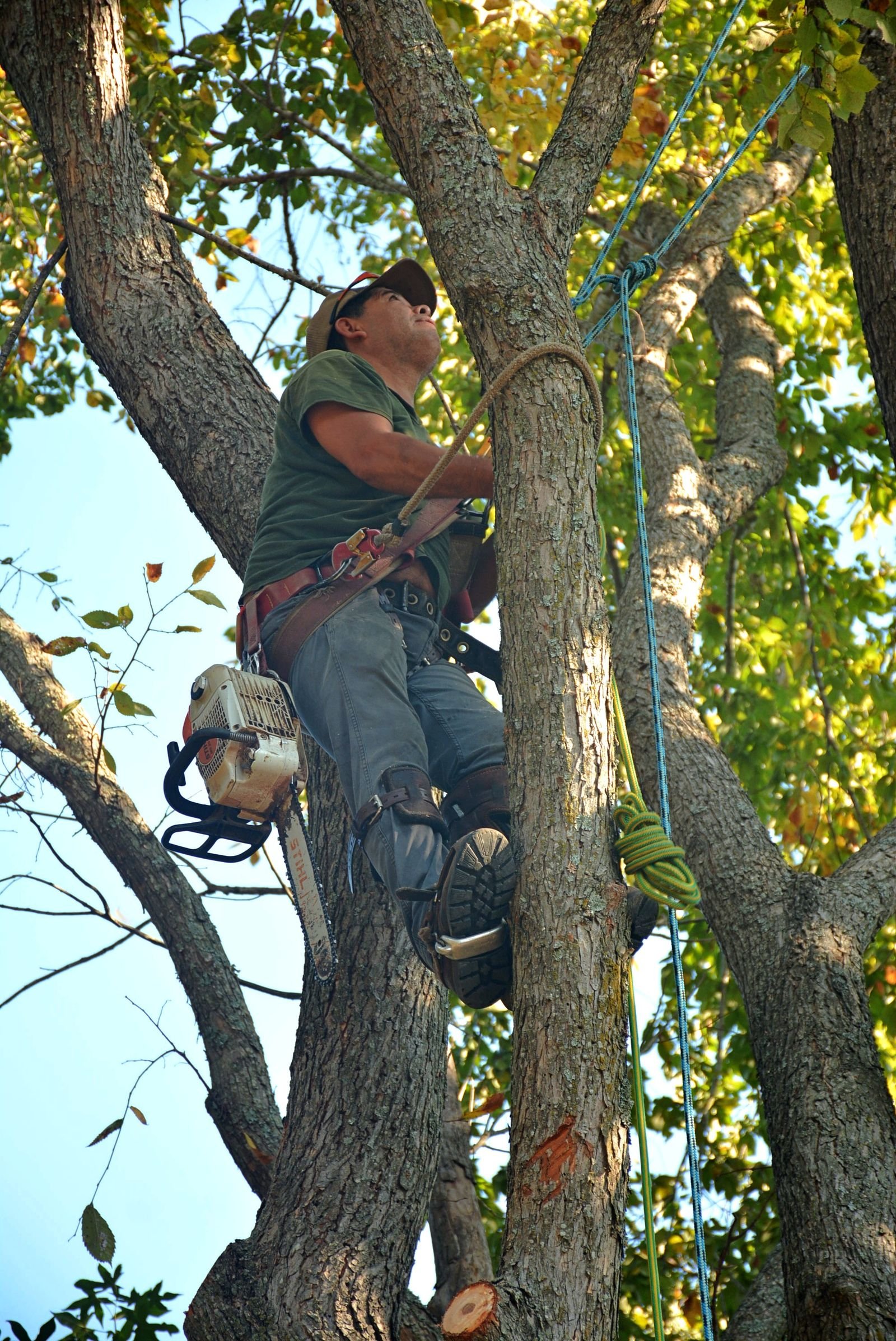
For trees near a house, garage, fence, or power line, the crew typically works the tree down in sections rather than felling it in one piece. That means climbing or using a bucket truck to reach the canopy, cutting limbs and top sections free, and lowering them on ropes so nothing drops uncontrolled near the structure. Ground crew stays clear of the drop zone and manages the rigging lines from below. Once the canopy is reduced, the remaining trunk gets cut down in manageable rounds, working from the top toward the base.
Brush and smaller branches usually go through a chipper on the spot, while larger rounds get cut to length and either hauled away or left for firewood if the homeowner wants it. The stump is normally left in place at this stage, since stump grinding is its own separate process with different equipment. Many homeowners choose to handle both in the same visit, and if that is something you are considering, our stump grinding team can grind the stump down below grade the same day the tree comes down, so you are not left staring at a raw stump all season.
What Affects the Cost
Every dead tree removal is priced based on a handful of real factors, not a flat rate. Height and trunk diameter matter most, since a 30 foot dead maple takes a fraction of the time and rigging that an 80 foot dead oak does. Proximity to structures, fences, sheds, and power lines adds time and careful rigging, which adds cost. Accessibility plays a bigger role than people expect. A tree in an open front yard with truck access is a much simpler job than one wedged into a fenced backyard where everything has to be carried out by hand or lowered piece by piece over a roofline.
A smaller dead tree in an open area with easy access often falls in the $400 to $1,200 range. A large dead tree close to a house or power line, especially one that needs careful rigging or a bucket truck, moves into a noticeably higher range, often $1,500 to $4,500 or more, because of the extra time, equipment, and crew size required to do it safely. Disposal adds a smaller factor too, since hauling away a full trunk and canopy takes more time than leaving cut wood on the property for the homeowner. See our full tree removal cost guide for a breakdown by tree size and situation. The only way to get an accurate number is to have someone look at the actual tree, which is why we offer free estimates for anyone in Syracuse and the surrounding area.
A dead tree does not send a warning before it fails. If you have a tree on your property that has lost its leaves out of season, has bark falling away, or just does not look right compared to last year, do not wait for a storm to make the decision for you. Our crew handles dead tree removal throughout Syracuse and the surrounding communities, and we can usually get out for an assessment within a few days. Call (315) 641-8222 to schedule a free estimate and find out exactly what that tree needs before the next storm decides for you.
Want it handled?
Our crews handle tree care, landscaping, drainage, and snow plowing across the Syracuse area. Get a free, no-obligation estimate.
Get a Free Estimate