
Storm Damaged Tree Removal: What We Look For
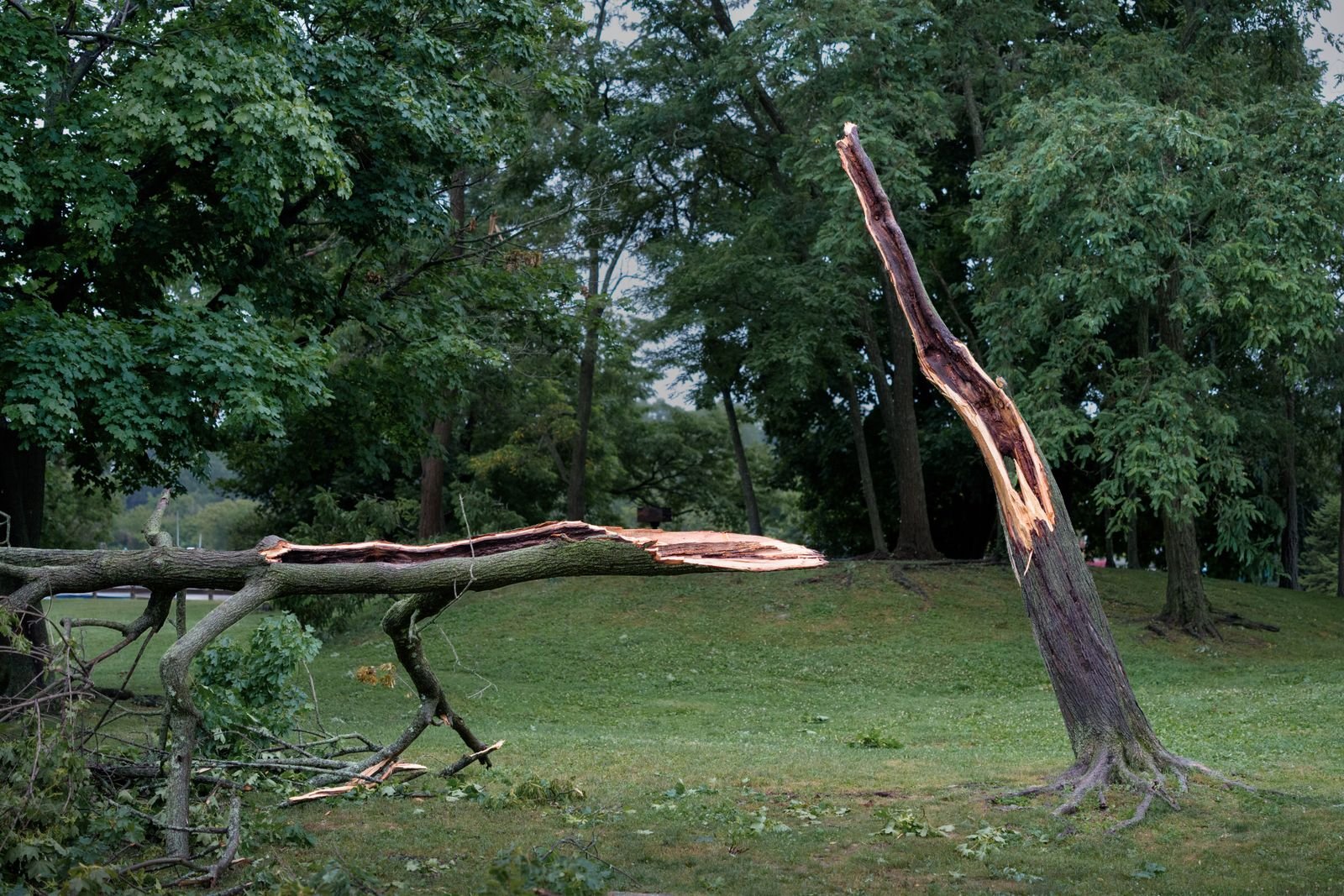
After a summer squall rolls through Central New York or a fall wind event knocks branches loose across Fayetteville and Syracuse, our phone starts ringing before the rain even stops. Storm damaged tree removal in Syracuse NY is one of the calls we handle most often, and it is rarely as simple as cutting down whatever fell. Every storm leaves behind trees that look fine from the driveway but are actually holding on by a few fibers of wood, and telling the difference between a tree that needs a trim and one that needs to come down takes a trained eye. Here is what our crew actually looks for when we pull up to a property after a storm.
Starting With a Full Walk Around, Not Just the Obvious Damage
Most homeowners call us about the branch that is clearly hanging over the driveway or the limb resting on the roof. That is the damage you can see. Before we touch a chainsaw, we walk the entire tree, base to canopy, because storms almost never damage a tree in just one spot. We are checking the root plate for any lifting or cracking in the soil, which tells us whether the tree shifted at the base even if the top looks untouched. We look at the trunk for vertical cracks that run with the grain, since those often mean the tree is splitting internally along a seam that will not hold through the next round of wind. We also check the overall lean. A tree that has always leaned a little is one thing. A tree that is now leaning further than it was last month, especially with soil disturbed around the roots, is a different problem entirely.
This kind of inspection matters because a tree can look mostly intact and still be a hazard. Wind loads stress wood fibers in ways that are not always visible from the ground, and a trunk that appears solid can have internal cracking that only shows up once you get a probe or a chainsaw into it. We would rather spend fifteen extra minutes checking a tree thoroughly than come back out for an emergency call once it finally lets go.
Why Storm Damaged Trees Are More Dangerous Than People Expect
A tree that has already been through a violent windstorm or a heavy wet snow load has usually absorbed more stress than a healthy tree ever should. Even if it stays standing, the wood fibers holding major limbs to the trunk can be partially torn, which is a condition arborists sometimes call included bark failure, or what we just call a hanger. A cracked limb that has not fully separated is one of the most dangerous things on a property because it can drop with no warning, often days or even weeks after the storm has passed and the sky is clear. We call these widowmakers for a reason, and they are the single biggest safety risk our crews plan around on every storm call.
Root damage is the other piece that is easy to miss. When wind rocks a tree hard enough, it can tear or stretch roots underground even if nothing above ground looks wrong. That tree might survive the next few storms just fine, or it might come down in a much lighter wind event six months later because its anchoring system was already compromised. This is part of why we recommend a professional look at any tree that took a hard hit, even one that seems to have shrugged it off.
How We Decide Between Removal, Trimming, or Cabling
Not every storm damaged tree needs to be taken all the way down. If the damage is limited to a single limb and the trunk, crown, and root system are all sound, targeted trimming and pruning can often save the tree and restore a safer structure. In some cases where a major limb is compromised but the rest of the tree is healthy, cabling or bracing can relieve stress on a weak union and buy the tree years of stable life. We only recommend removal when the structural damage is severe enough that saving the tree would leave a standing hazard, whether that is a split leader, a snapped top, extensive root plate movement, or a lean that has changed since the storm.
Species matters here too. Some trees common around Fayetteville and the greater Syracuse area, like silver maple and Bradford pear, are naturally weak wooded and prone to splitting even in moderate wind. Those trees often do not recover well from major storm damage the way a white oak or a healthy hickory might. We factor in the tree’s natural strength and its history, not just the damage sitting in front of us that day.
What the Removal Process Looks Like After a Storm
Once we have determined a tree needs to come down, the approach depends heavily on what is around it. A tree damaged in an open yard with no structures, fences, or power lines nearby can often be dropped in sections using standard climbing and rigging techniques. A tree leaning toward a house, a garage, or a neighboring property requires a much more careful piece by piece takedown, sometimes with a crane if access allows for it, so that every cut is controlled and nothing swings unexpectedly. Storm sites often have downed limbs and debris scattered everywhere, so we usually clear a safe working zone first before any cutting starts.
We also document damage as we go, especially for homeowners who are filing an insurance claim. Photos of the break points, the root condition, and the final debris pile can make a real difference when you are working with an adjuster. If you are dealing with a full tree removal after a storm, our tree removal service covers everything from the initial assessment through cleanup and haul away, and if the stump is left behind we can follow up with stump grinding so the area is usable again.
What Storm Damaged Tree Removal Typically Costs
Pricing after a storm depends on a handful of real factors rather than a flat rate. Tree size and species play a big role, since a mature oak takes far more time and equipment than a mid sized maple. Access matters just as much. A tree that fell into a fenced backyard with no truck access costs more to remove than one sitting in an open front lawn. Proximity to a house, a shed, power lines, or a neighbor’s fence adds complexity and often requires slower, more careful rigging rather than a quick drop. Multiple trees down on one property can sometimes bring the per tree cost down slightly since we are already mobilized on site. Most storm cleanup jobs in the Syracuse area land somewhere in the low hundreds for a small limb job up to several thousand dollars for a large, hazardous removal near structures. We always walk the property and give you a real number before any work starts, not a guess over the phone.
Call Us Before the Next Storm Does More Damage
If a recent storm left a tree leaning, cracked, or dropping limbs on your property in Fayetteville, Syracuse, or anywhere nearby, do not wait to see what the next round of wind does to it. Our crews are trained specifically to assess storm damage safely and give you a straight answer about whether a tree can be saved or needs to come down. Call RR Landscaping and Tree Services at (315) 641-8222 for a fast on site evaluation, and let us take the risk off your property before it becomes an emergency.
Want it handled?
Our crews handle tree care, landscaping, drainage, and snow plowing across the Syracuse area. Get a free, no-obligation estimate.
Get a Free Estimate